
April 29, 2026
Shelterbelt and Windbreak Management for Saskatchewan Farmers: When to Clear, When to Prune
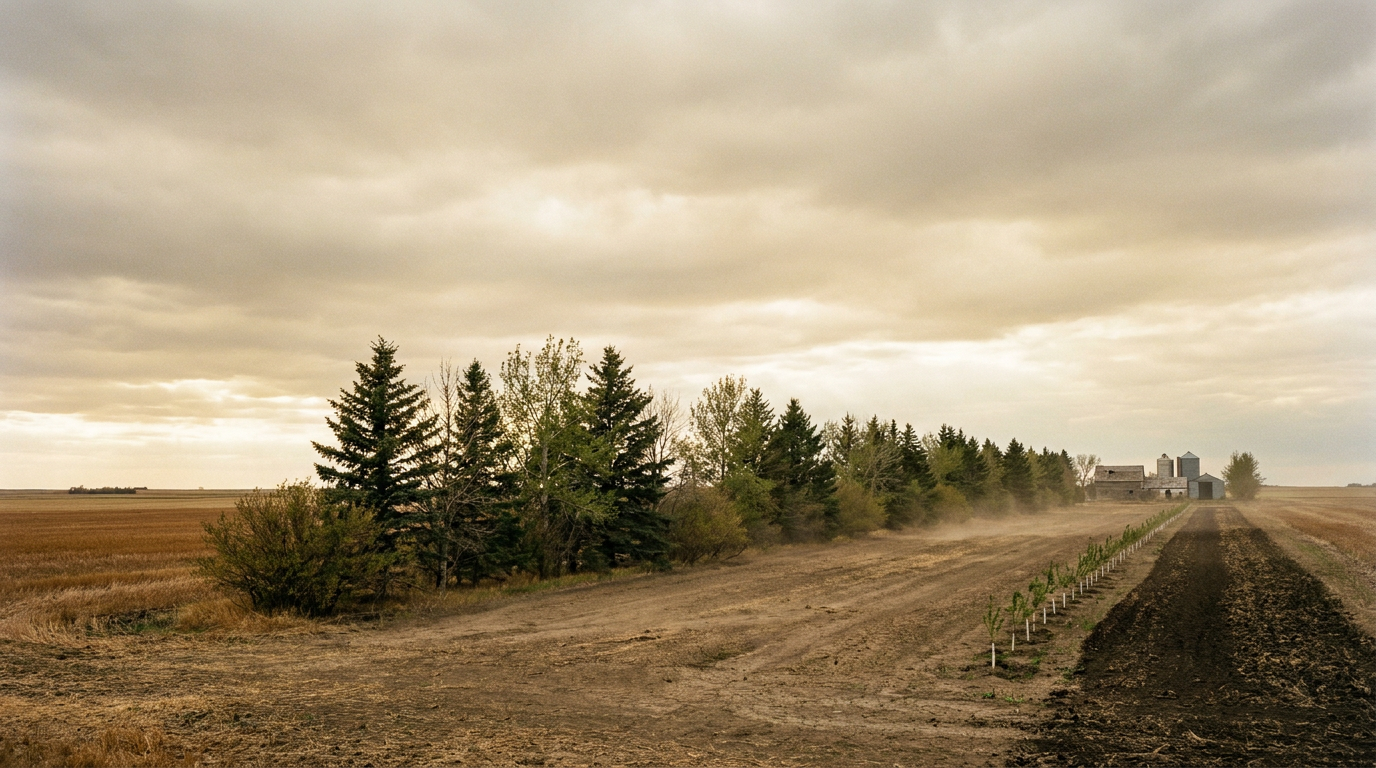
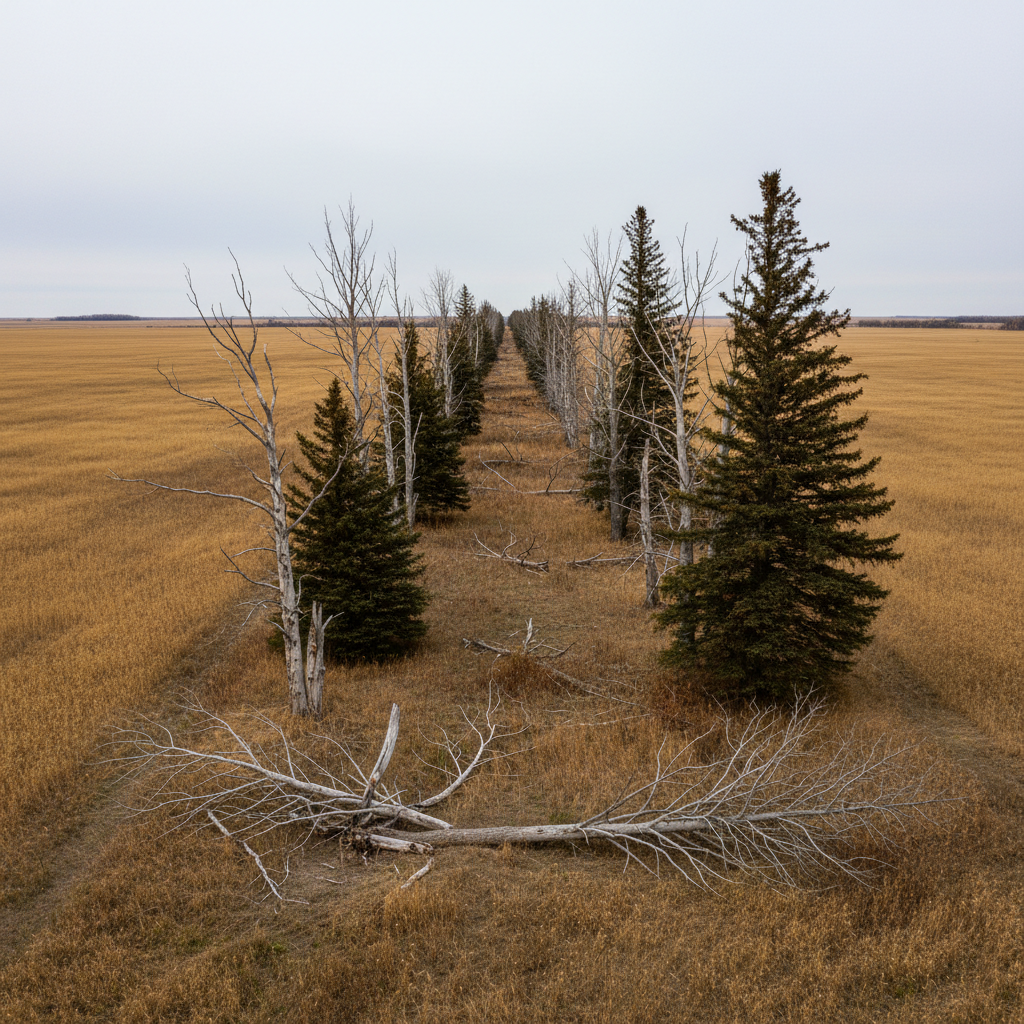
The row of trees your grandfather planted in the fifties is half dead. The north end is solid spruce, still doing its job. The middle stretch is a mess of leaning poplars and gap-toothed holes where trees have come down in the last few windstorms. The south end is overgrown enough that you’ve lost a strip of cultivated headland to encroaching roots and canopy shade. Shelterbelt removal Saskatchewan farmers deal with eventually, whether it’s one bad row or the whole windbreak.
You know something needs to happen. You’re just not sure if you need to take the whole row out, fix the bad section, or do something in between.
This is the situation a lot of Saskatchewan farmers are sitting with right now. Across the prairies, a lot of the shelterbelts planted through federal programs in the 1960s through the 1990s are now decades old, and many of them are past their best or heading that way. Knowing what your options are and when the window opens for that kind of work is what this guide covers.
What Shelterbelts and Windbreaks Actually Do
Shelterbelts and windbreaks are planted rows of trees or shrubs, typically running perpendicular to prevailing winds, that serve a set of practical functions on a farm operation.
Wind protection for crops and soil. Alberta Agriculture’s shelterbelt guide puts the protected area on the downwind side at about 20 times the average height of the trees. On the flat prairie landscape of Saskatchewan, where exposed fields can see sustained wind that strips topsoil and desiccates spring crops before they’re established, that protection zone matters.
Snow management. Shelterbelts trap and redistribute blowing snow, depositing it on field margins and reducing drift accumulation on roads and yards. This is particularly relevant in the northern grain belt near Lloydminster and the North Battleford area.
Livestock shelter. Shelterbelt rows adjacent to pasture or yard sites provide wind protection for cattle and horses, reducing feed requirements and stress-related weight loss in extreme cold.
Field microclimate. A functioning shelterbelt moderates temperature extremes in the protected zone, which can extend the effective growing season slightly and reduce moisture evaporation from topsoil in the protected corridor.
The PFRA Shelterbelt Legacy and Why So Many Need Attention Now
In 1901 the federal government set up the Forest Nursery Station at Indian Head, Saskatchewan, to grow and supply hardy trees and shrubs to prairie farmers, according to the Encyclopedia of Saskatchewan. Over the decades, the program that became the PFRA Shelterbelt Centre supplied species like American elm, caragana, green ash, Manitoba maple, poplar, willow, larch, pine and spruce to farms across the prairies.
The federal government closed the shelterbelt centre at the end of 2013, as CBC reported at the time. But the legacy of that program is still sitting on farms across the prairies in the form of rows planted between 1950 and 2000 that are now approaching or past their biological lifespan.
How long a shelterbelt stays useful depends on the species, the site and how it’s been looked after. Fast-growing trees like poplar tend to decline sooner, while spruce often holds up longer under good conditions. A row planted in 1970 is more than 55 years old today, and a row planted in 1985 is past 40. Either way, it’s worth walking the row and taking an honest look.
For planning help after the federal program ended, Saskatchewan farmers can look to groups like SaskAgroforestry and the Saskatchewan Ministry of Agriculture.
Signs Your Shelterbelt Has Reached End-of-Life
Not every aging shelterbelt needs to come out. But there are clear signs that a row is declining past the point where maintenance pays off.
Structural gaps. A field shelterbelt has to be continuous to work. Alberta Agriculture’s shelterbelt guide warns that where there are gaps, weather damage is accelerated in the areas behind them, so a gappy row can do more harm than good in spots.
Significant dead and dying stems. When a large share of the row is dead or showing major dieback from disease, insects or age, selective pruning alone usually won’t bring it back.
Disease pressure spreading. Dutch elm disease, canker diseases in poplar, and other pathogens spread through root contact and airborne dispersal. A row with active disease pressure in several trees is likely to lose more in the coming years. In that situation, removing the row and replanting with resistant species is often the better long-term investment.
Root encroachment reducing cultivated area. Older poplar and ash shelterbelts develop aggressive lateral root systems. When shelterbelt roots are reaching well out into your cultivated headland, the row is costing you productive land. That cost compounds over years.
Reduced wind protection from canopy thinning. As trees age and die back, crown density decreases even in trees that are still standing. A row of spindly, gaunt older trees with thinned canopy isn’t delivering the wind protection a healthy dense row does.
Snow trap performance declining. If you’ve noticed changes in snow distribution patterns around a shelterbelt row over the past several years, that’s often a sign of structural decline affecting the aerodynamic function of the row.
The Clearing Decision: Full Removal, Selective Pruning, or Rejuvenation Underplanting
Once you’ve assessed that a shelterbelt needs work, you have three basic options.
Full Removal
Full removal makes sense when a row is predominantly dead or diseased, when you need to recapture the headland for cultivation, or when you’re planning to replant with a new row in a better location. It’s also the right call when disease pressure is severe enough that leaving any material on-site creates ongoing risk.
Full removal with a mulcher is the cleanest approach on cultivated land. The chip mat is returned to the field surface, where it breaks down and contributes to soil organic matter over several seasons. There’s no debris windrow to deal with, no burning required, and no large pile of brush to haul. The ground is clear and trafficable within hours of the crew finishing.
Selective Pruning and Deadwood Removal
If a row is structurally sound but has sections with dead material, crown overreach into field margins, or lower limbs that need clearing for equipment clearance, selective pruning and deadwood removal can extend the useful life of the row without full removal.
This approach works best on younger rows or on species like spruce that maintain structural integrity longer. It’s less effective on heavily gapped or disease-affected rows where the structural function is already compromised.
Rejuvenation Underplanting
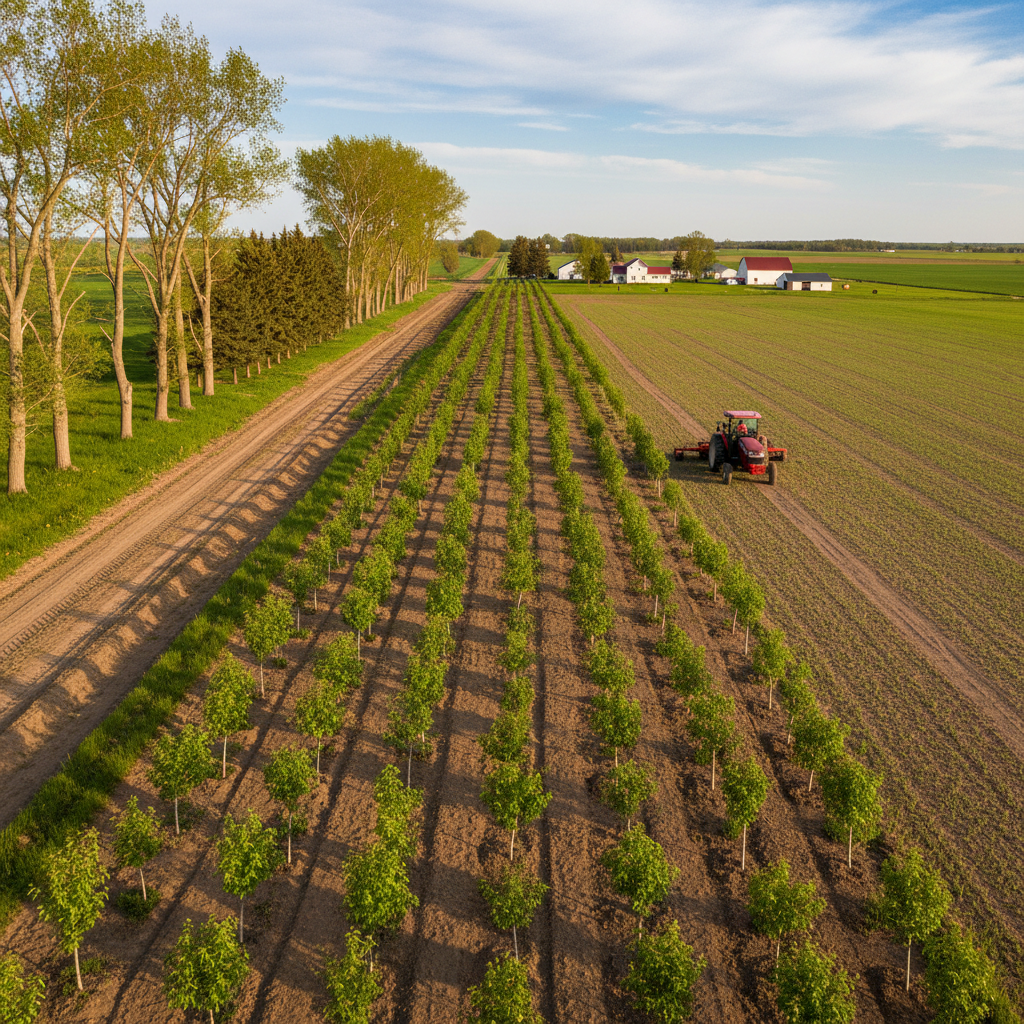
On rows where the existing trees are still structurally sound but gaps have opened up, strategic underplanting of new seedlings within or adjacent to the existing row can restore wind protection over several years as the new plants establish.
This approach requires that the existing trees aren’t creating too much canopy competition or root pressure for new plantings to survive. It works best on rows with isolated gaps rather than widespread decline.
In practice, many farmers end up doing a combination: removing the dead and diseased sections completely, pruning the healthy sections for crown clearance and crown shape, and underplanting where gaps exist in otherwise sound portions of the row.
Why Mulching Is the Preferred Method for Shelterbelt Removal on Cultivated Land
The traditional approach to shelterbelt removal was to use a dozer to knock the trees and either burn the debris in place or pile it for removal. On cultivated land, that approach has real downsides.
Burning a debris windrow on or beside a cultivated field leaves an ash patch you can see in the crop for years, can make for rough going with seeding equipment, and depending on where you are and when, may need a burn permit and the right weather. Push-and-pile with debris removal means trucking out material, which has cost and logistics implications.
Mulching eliminates both problems. A tracked mulching unit runs along the shelterbelt row, grinding all stems and woody material into a chip mat that stays on site. The chips break down over the following seasons depending on how deep they are and the soil, adding organic matter to the field margin. The ground is left flat and trafficable immediately after the mulcher passes. Your seeding equipment can run over the chip mat in the following spring without obstruction.
The other advantage of mulching on cultivated field margins is the equipment footprint. A tracked mulching unit operates within the row width and has a low ground pressure footprint compared to a dozer or large excavator. On land that hasn’t had heavy equipment on it before, and where you’re concerned about subsoil compaction, tracked mulching equipment is the right tool.
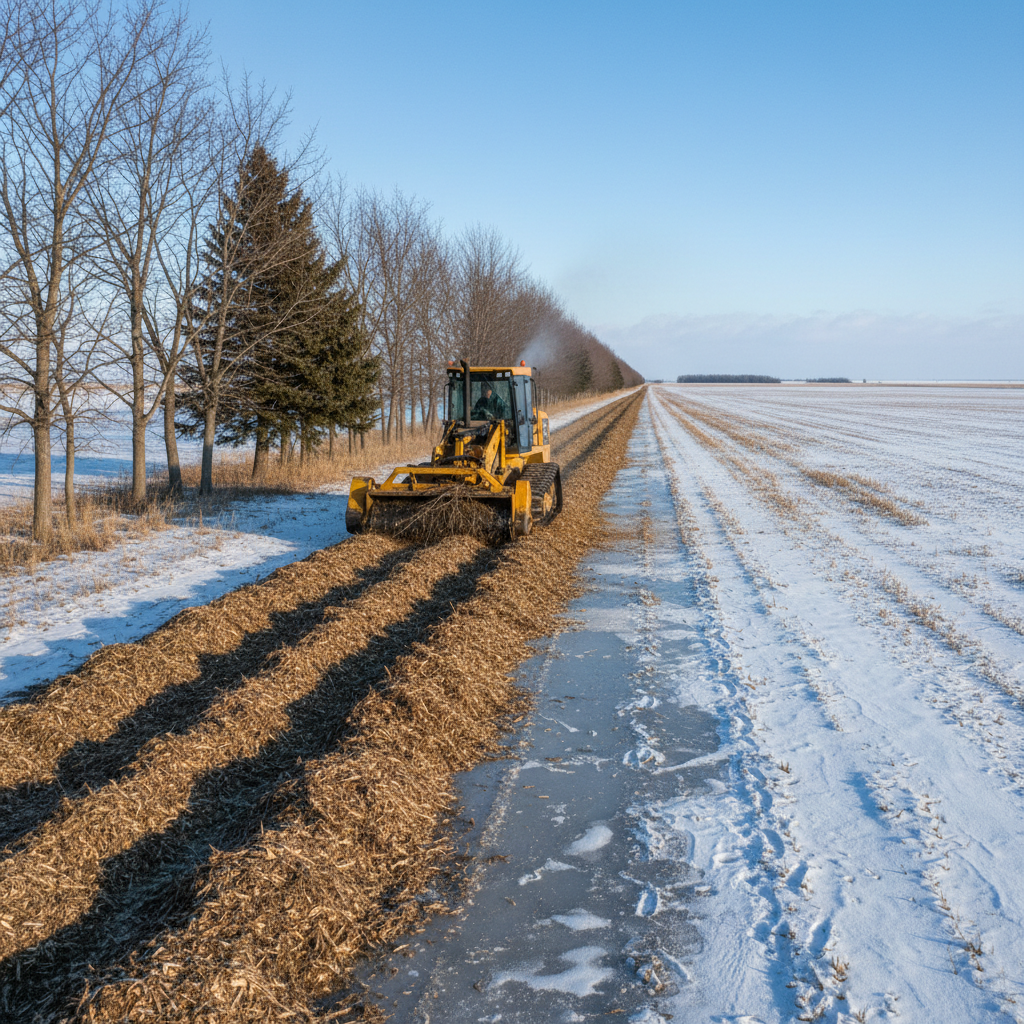
For tight headlands where a shelterbelt row runs close to a fence or field boundary, the head width and machine manoeuvrability of a purpose-built mulching unit typically means less collateral disturbance than trying to work the same area with a large push-blade.
Timing Your Shelterbelt Removal in Saskatchewan
The two best windows for shelterbelt removal in Saskatchewan are fall (post-harvest, October through November) and early winter (December through February), both for operational and agronomic reasons.
Fall access after harvest means the adjacent field is clear of crops, so you have full access to the work zone without risk to standing grain. Soil conditions in October are typically firm enough for tracked equipment without the frost dependence of mid-winter work, but dry enough to avoid the wet-spring compaction risk.
Frozen ground access in winter is the preferred window for anything involving wet or marginal soils, particularly along field margins with high organic content or areas prone to spring flooding. A tracked mulching unit on frozen ground leaves a fraction of the soil disturbance compared to the same equipment on thawed wet ground.
Summer work is possible but carries the most risk of soil disturbance and compaction in wet areas, and access around crops limits options. Spring work between seeding and harvest is generally the worst window for both soil condition and operational access reasons.
FAQ
How do I know if my shelterbelt needs full removal versus just pruning?
Look at how much of the row is dead or dying and how big the gaps are. If a large share is dead, or big gaps have opened up, the wind protection is already compromised and pruning alone won’t fix it. Younger rows with isolated dead material, or hardier species like spruce, are usually better candidates for selective pruning or deadwood removal instead of full removal.
What’s the best time of year to remove or clear a shelterbelt in Saskatchewan?
Fall, from October through November, right after harvest, and early winter with frozen ground, from December through February, are the two best windows. Fall gives you clear field access with firm-but-not-frozen soil. Frozen ground in winter minimizes compaction on wet or marginal soils. Spring between seeding and harvest is generally the worst window for both soil condition and access.
Will removing a shelterbelt hurt my soil or field productivity?
Mulching the row and leaving the chip mat on the ground actually adds organic matter back into the field margin as it breaks down. That’s a very different result from burning debris and leaving an ash patch. The bigger productivity question is usually the opposite: an old shelterbelt with aggressive roots can already be costing you cultivated headland, so removal often recovers productive land rather than costing you any.
Can I replant a new shelterbelt in the same location after removal?
Yes, and many farmers do, either right in the old row footprint once it’s mulched and cleared, or in a repositioned line that better fits current equipment widths and field layout. If the old row is only partially declined, rejuvenation underplanting alongside the surviving trees is often a faster path back to a functioning windbreak than starting over from bare ground.
Is mulching better than burning for shelterbelt debris on cultivated land?
For most cultivated-field situations, yes. Burning can need a permit and the right weather, and it leaves an ash patch in the field. Mulching grinds everything into a chip mat on site, no burn permit, no debris windrow to haul, and the ground is trafficable within hours of the crew finishing.
Cross-Border Capability: AB/SK Work from Bonnyville
Pevach Corp operates out of Bonnyville, Alberta, a short drive from the Saskatchewan border. That puts the team within practical range of the North Battleford, Lloydminster, and Meadow Lake areas, and the Saskatchewan farmland running along the AB/SK boundary.
For Saskatchewan farmers evaluating shelterbelt removal, selective clearing, or full row management, the same equipment and crew doing pipeline ROW and industrial land clearing in northeastern Alberta is available for agricultural work in Saskatchewan. The fleet includes tracked mulchers with 3.2 psi ground pressure, suited to both the flat terrain and the tight field margins typical of prairie shelterbelt work.
If you’re working through a shelterbelt assessment and want to talk through what the work actually involves, get in touch through pevachcorp.com for a consultation or quote request. The right time to start that conversation is before the fall season fills up.
